Glassing and Fairing a Catbird 16 Lugsail Yawl.

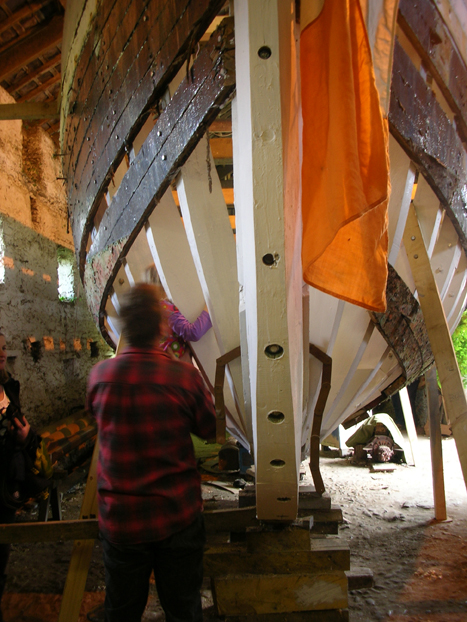
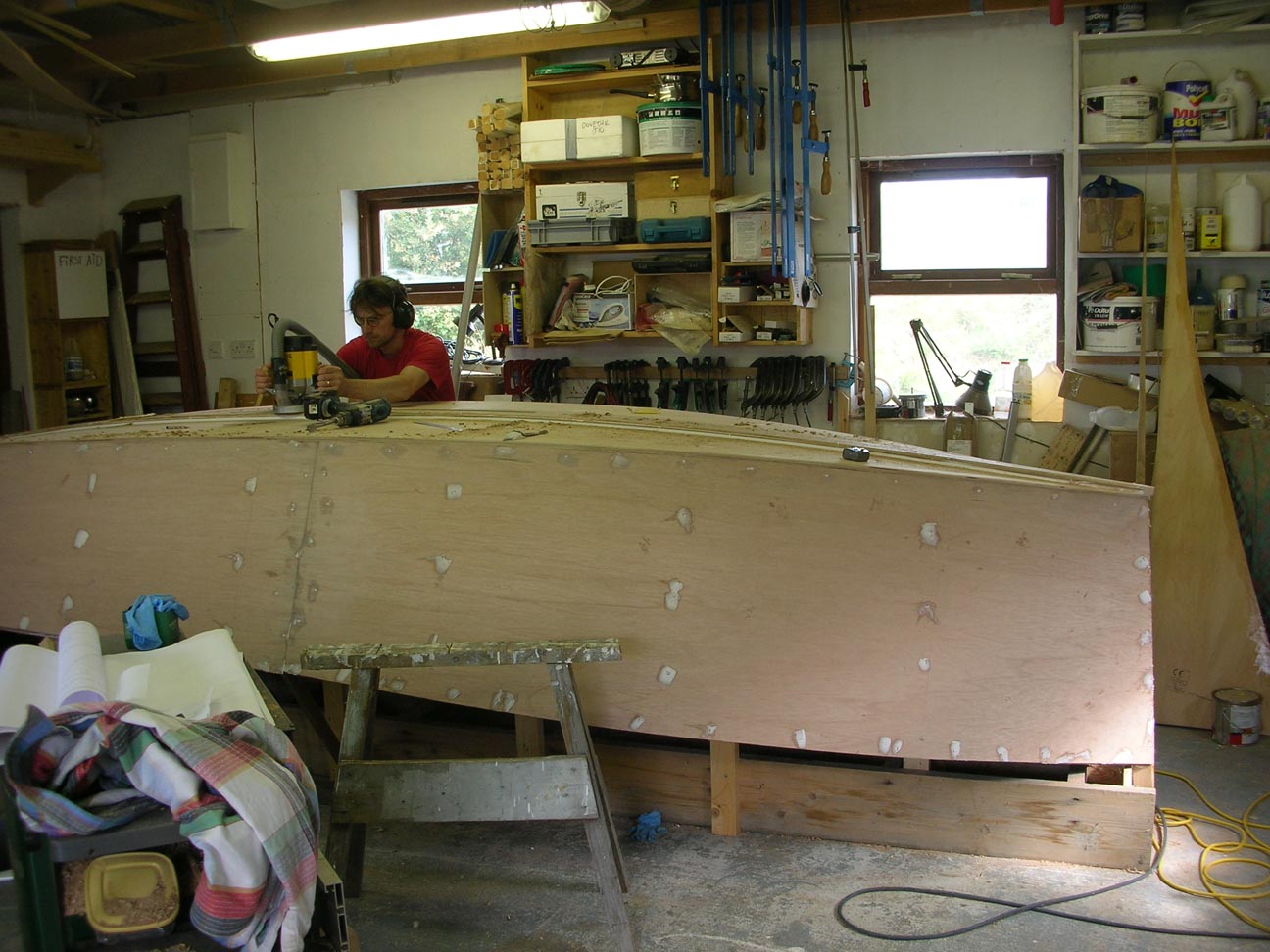
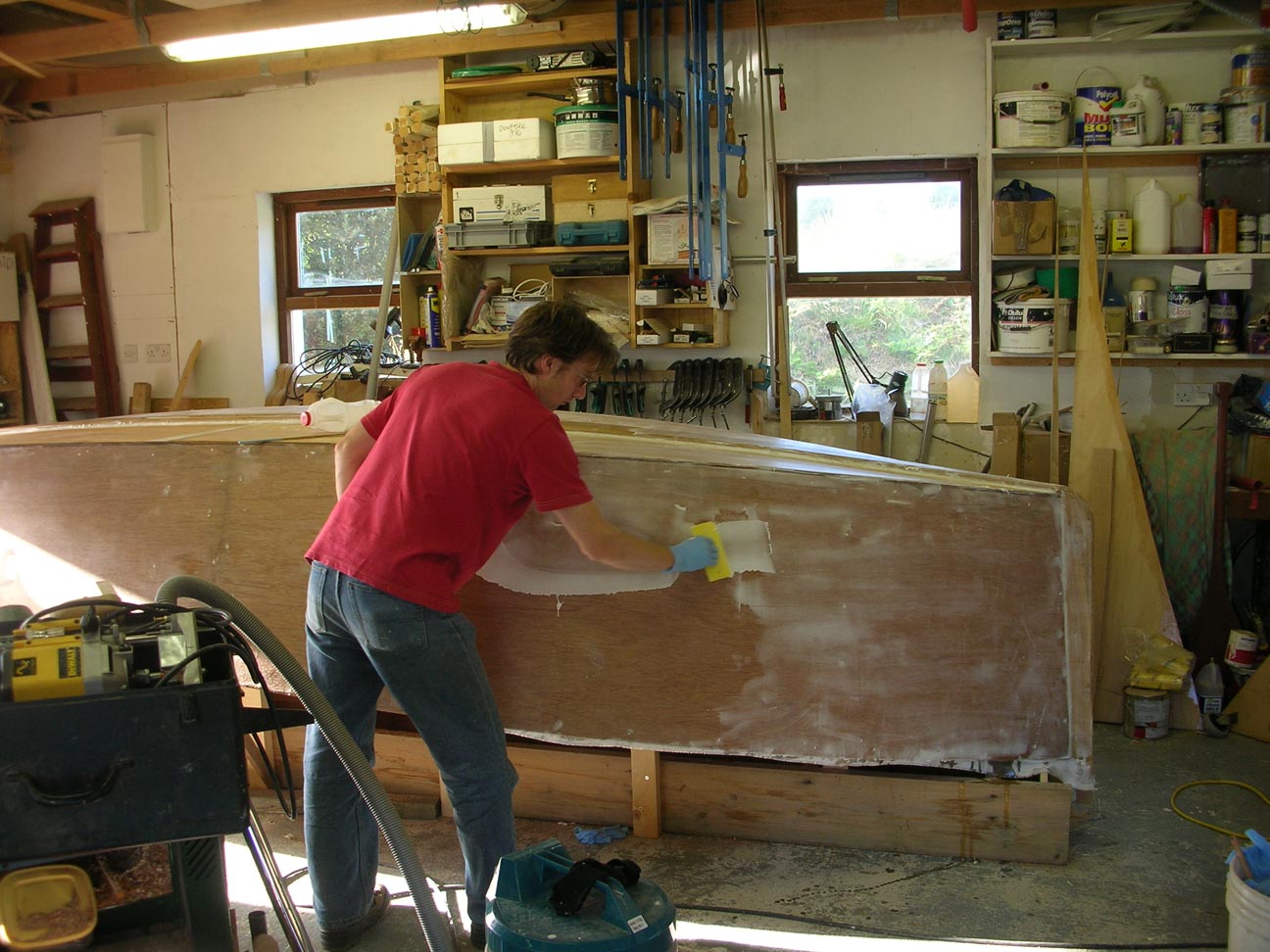
Well I’ve trimmed back the bottom planking and Attached the white oak keel. In the photo below you can see me trimming the opening of the centreboard slot with a router and pattern bit so that it will match the centreboard case exactly. This was followed by a pass with a 9mm round-over bit to give the opening an nice rounded edge. If there is one thing you don’t want on a boat it is a sharp edge. Well maybe on the trailing edge of a rudder or centreboard and of course your knife. Rapier sharp wits are optional. Cutting the centre board slot in th ekeel of a Catbird 16 lugsail sharpie, by Roeboats, West Cork, Ireland, For sale.Once the hull was sanded and all the edges are nicely rounded it was time to sheathe the hull in fibreglass and epoxy resin. This was a time consuming but undifficult operation. I left the skeg off until the hull was sheathed to make it a bit easier to sheath around this area. You can also see that I have added the outer stem piece before sheathing.Catbird 16 lugsail sharpie hull sheathed in epoxy and fiberglass, by Roeboats, West Cork, Ireland, For sale.The next step was to apply a thin layer of fairing compound to help fill the weave of the cloth and smooth out any wrinkles (there were none of course). I emphasise a thin layer because most if not all of the fairing was done to the framework before the planking was applied. Like hanging doors where he who makes the frame should hang the door the same applies to fairing, he who applies the fairing compound should be the one to sand it off. Fairing the hull of a Catbird 16 lugsail yawl sharpie by Roeboats, West Cork Ireland, For sale
Check back next week for further progress or why not subscribe to the blog using your preferred method e.g. feedburner RSS feed or use the email subscription to the right of the screen. Or better yet subscribe to the Roeboats Quarterly Newsletter

Roeboats, Ballydehob, Co. Cork, t:+353 (0)28 38973 m: +353 (0)86 158 69 37 e:roeboats@ymail.com

Home

Planking of 16 foot Lugsail Yawl Sharpie

Well progress continues with the building of the 16 foot Catbird lugsail Yawl. As you can see I started with the side planking which I had already cut out to shape. This was provided with the plans so I didn’t have to do any spiling. I decided to butt strap the side planking and scarf the bottom. Scarphing the bottom ensured that there was no obstruction for water to gather behind in the bilge.Planking wooden 16 foot lugsail yawl sharpie Catbird 16 by Roeboats, cork Ireland, for sale

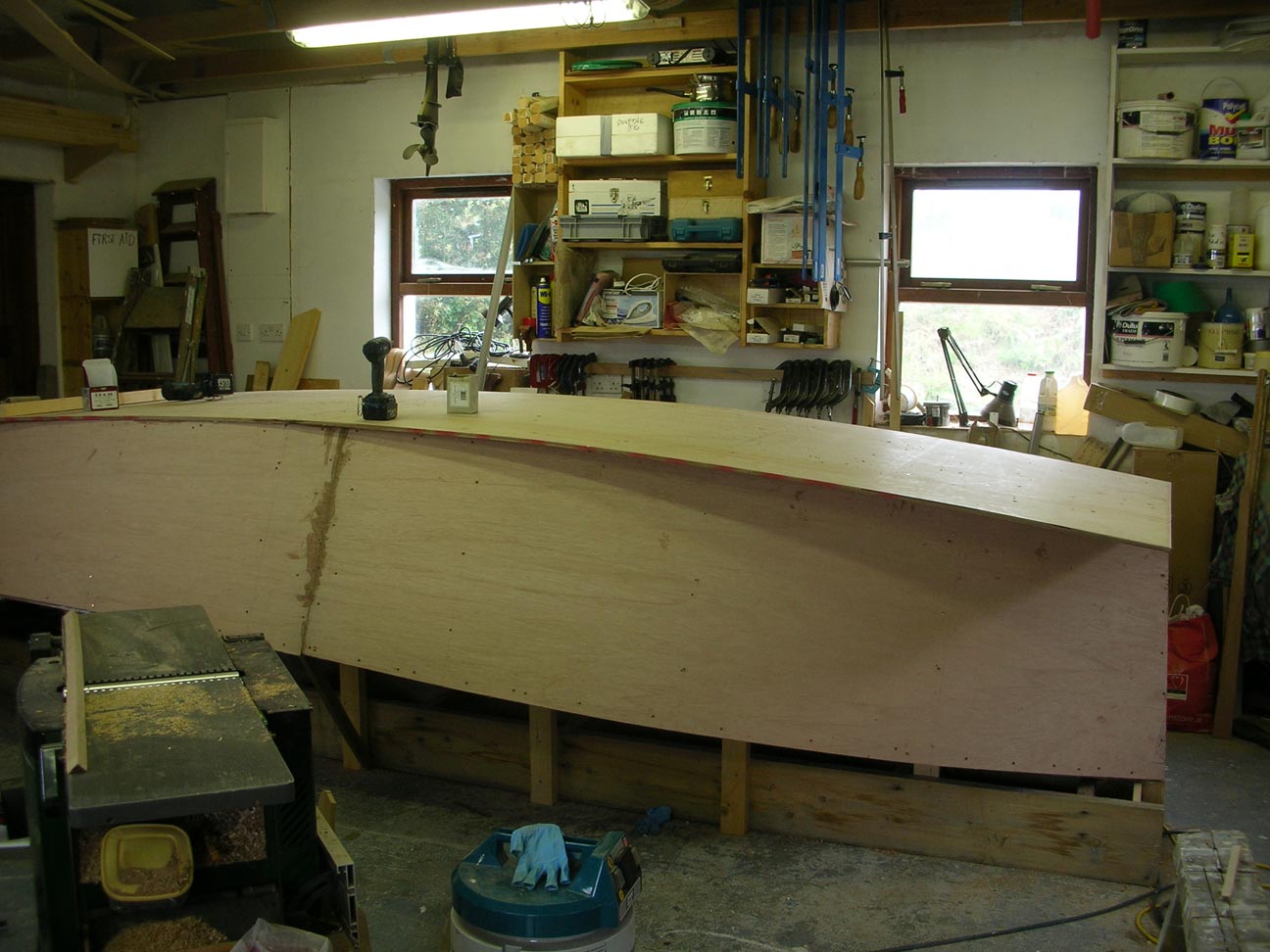
All of the planking was coated in three coats of epoxy resin and sanded before assembly. It was easier to do it now than when assembled. I would have liked to have six foot long arms when I was putting the bottom sheets on or at least a helper. It was a little tricky lifting the forward sheet clear of the glue spread on the frames and chines and placing it square to the centreline. The aft sheet was easier. You can now get a good impression of the boats size. She’s a pretty voluminous boat for here modest length and beam.Bottom planking of wooden 16 foot lugsail yawl sharpie by Roeboats Cork Ireland , For Sale

Anyway here she is planked up. I didn’t cut the bottom planks before glueing them down. I’ll trim back to the side planking when the epoxy has dried. Next step is the filling of all the screw hole etc. prior to attaching the keel and glassing the hull. If you’d like to get more info from Roeboats about upcoming projects and news why not subscribe to Roeboats Quarterly Newsletter by clicking here. Or if you would like your own custom boat built why not give me ring or send me an e-mail at the contact below. I’m always interested in talking about boats.

Roeboats, Ballydehob, Co. Cork, t:+353 (0)28 38973 m: +353 (0)86 158 69 37 e:roeboats@ymail.com
Home

Chine, Stem and plank scarphing

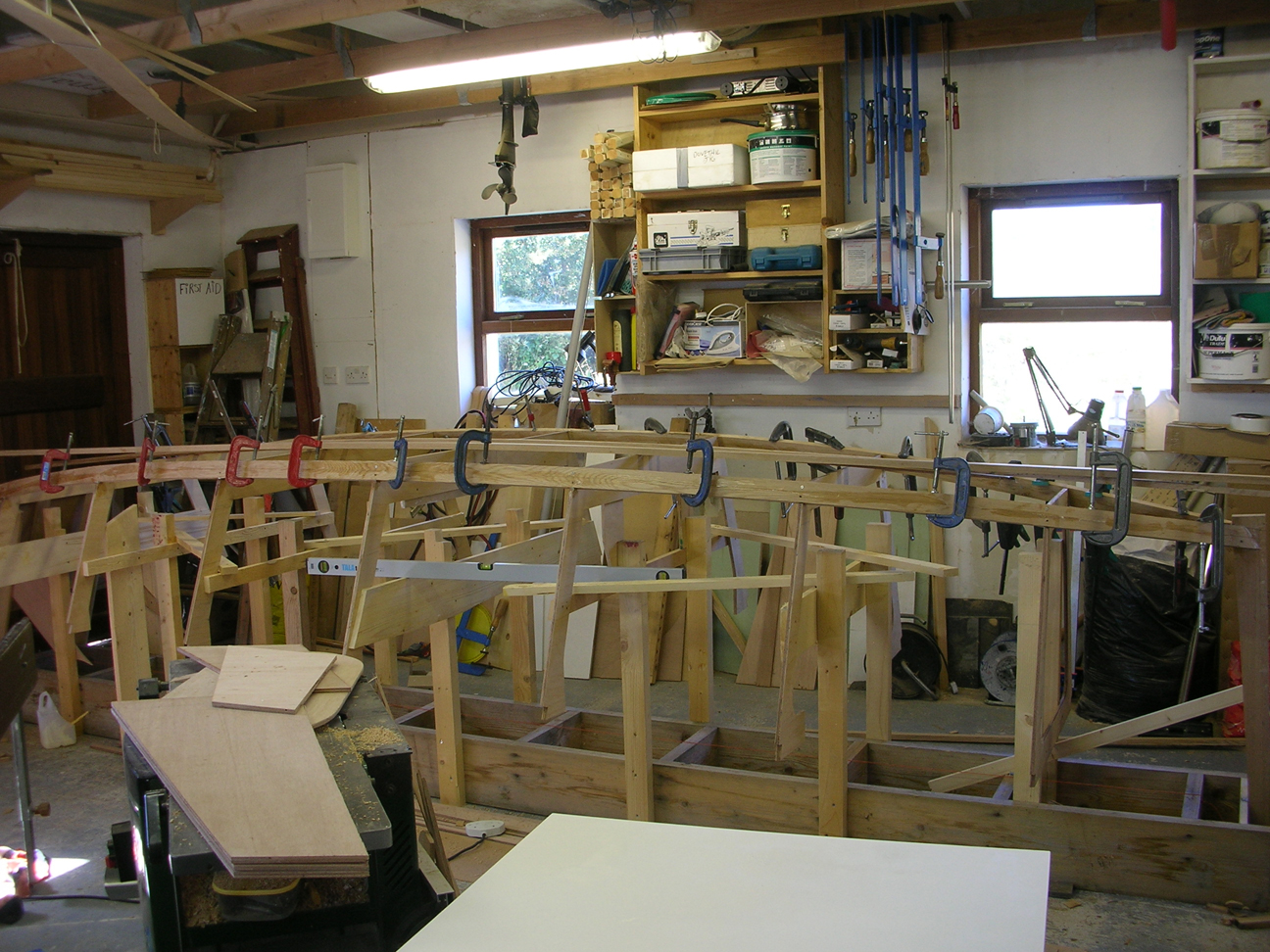
Here are the nexts steps in building the Karl Stambaugh’s Catbird 16 Lugsail sharpie yawl. First up is attaching the chine  which had to be laminated up to take the  tuck up at the stern but it went in fairly easily just took twice the glueing time.

The gunwales were next to go on and it ‘s always a bit nerve wracking putting the gunwale on a boat that is upside down as it is very difficult to be sure that the sheer will have a pleasing sweep and not have what’s called powderhorn. The dread of every boatbuilder. Once botht the chine and gunwale were on it was time to cut the bevel in the stem which was aa straighforward affair as the Catbird has a two part stem for ease of construction.

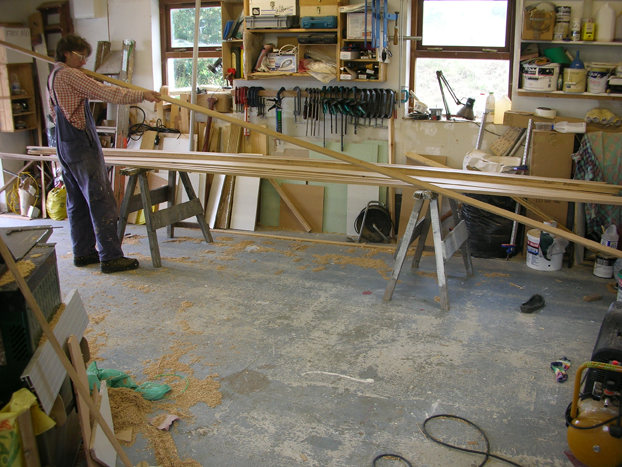
Below you can see me finishing off the scarphing of the bottom planking. In the foreground is the centreboard being laminated up. That’s all for now work got a little side tracked today as I was showing a potential client the Ninigret I built last year. I had forgotten how much fun she is in the water.

Roeboats, Ballydehob, Co. Cork, t:+353 (0)28 38973 m: +353 (0)86 158 69 37 e:roeboats@ymail.com
Home

Setting up Frames of Catbird 16 lugsail yawl sharpie

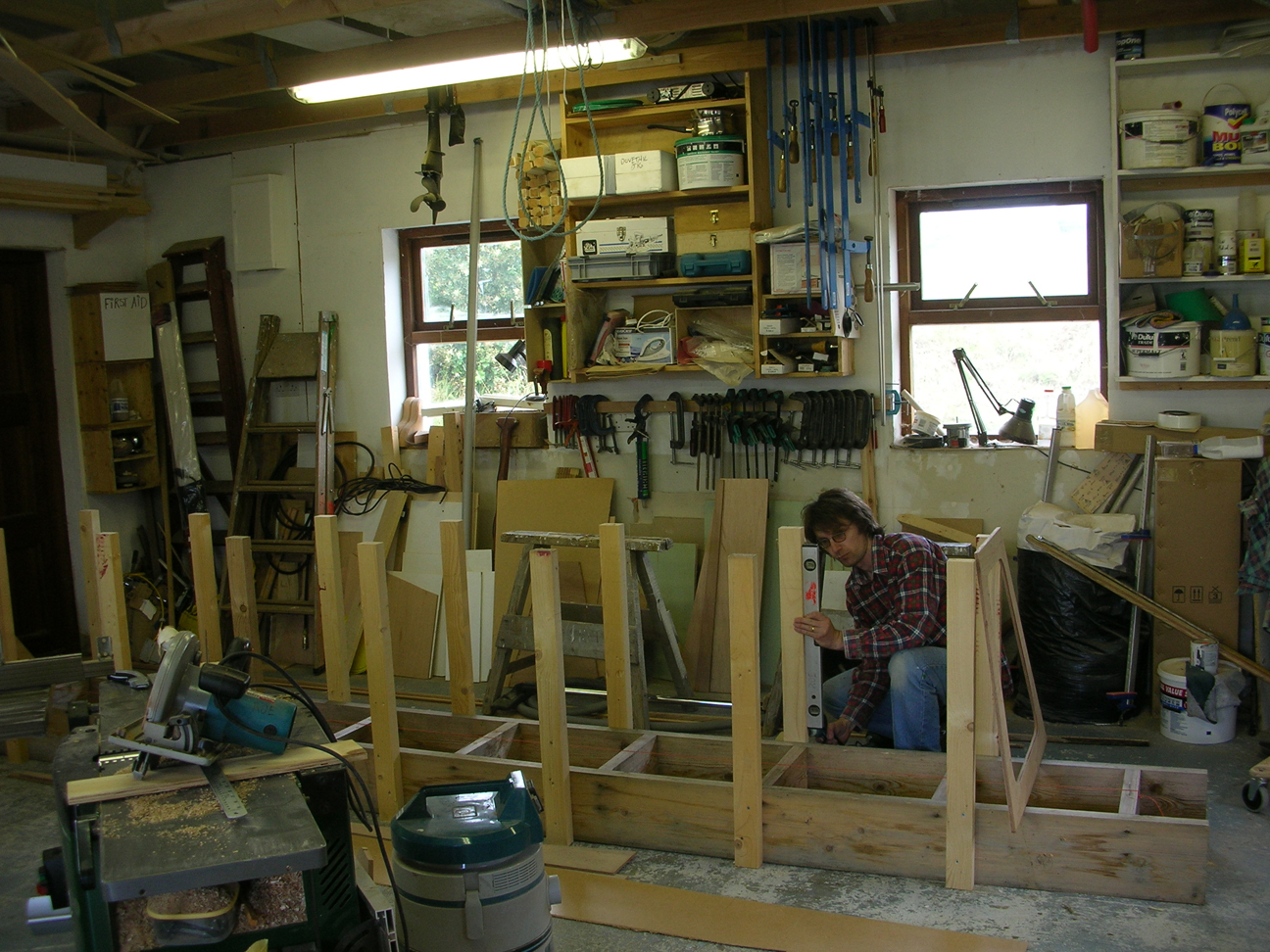
Here are a few photos of setting up the frames for the Karl Stambaugh Catbird 16 lug sail yawl sharpie. Each frame has to be centred, levelled and plumbed. They are then all brace together so they won’t move during the planking of the boat.

Setting up frames for wooden sharpie lug sail yawl boat

Setting up frames for wooden sharpie 16 foot lug sail yawl

Setting up frames for wooden 16 foot sharpie lug sail yawl by Roeboats

Roeboats, Ballydehob, Co. Cork, t:+353 (0)28 38973 m: +353 (0)86 158 69 37 e:roeboats@ymail.com

Home

First Steps in Building Of Catbird 16 foot Sharpie.

Here are a few photos of the first steps in building a wooden 16 foot sharpie sailing boat. First the wood for the chines, inwales, and keel are jointed and planed to thickness. Here I’m checking them for square and straightness.

Checking wood for 16 foot sharpie sailboat custom built by Roeboats, Co. Cork

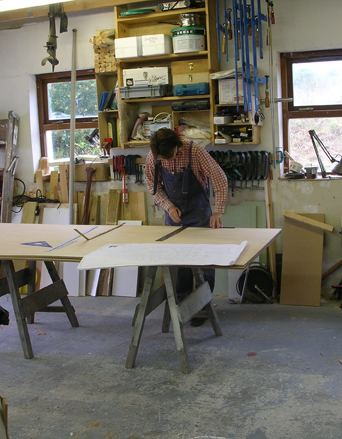
Then I have to mark out the frames on the sheets of half inch plywood. I nested the frames as best I could on the sheets to reduce wastage. This was fairly easy to do as as the sharpie hull shape is very economical with materials. One of the reasons that it has remained a very popular traditional hull form. Perhaps more boats should be flat bottomed wooden boats. Of course more boats should be wooden boats. Marking out the frame material for a 16 foot sharpie sailboat custom built by Roeboats Co.Cork IrelandThen the frames had to be cut out with a hand circular saw and a guide rail. I did use a jigsaw in some locations but the circular saw is much quicker and leaves a straighter cut.

Cutting out the frames fro a 16 foot wooden sharpie sailboat custom built by Roeboats Co. Cork IrelandWell that’s all you are getting to see so far. We actually seem to be having some Summer weather here in Ireland for the first time in years and it is getting very very hard to stay in the workshop and not just go sailing.

Roeboats, Ballydehob, Co. Cork, t:+353 (0)28 38973 m: +353 (0)86 158 69 37 e:roeboats@ymail.com

Home

Roeboats to build Karl Stambaugh Catbird 16 Lug sail day boat

catbird16_yawl wooden daysailor built by Roeboats, Cork Ireland for saleRoeboats have been commissioned to build a 16 foot sharpie designed by Karl Stambaugh. The owner will be finishing her himself so she’ll leave the workshop without paint, rigging or sails. Hopefully I’ll get to sail her at some point. The lug rig should prove powerful and versatile and it looks pretty good too. The finished boat will be sailed on Galway Bay where the 2011-2012 Volvo Ocean Race will finish. I’ll be posting the building of the boat as it progresses so check back to see how I’m getting on or better still subscribe to the blog or Roeboats Quarterly newsletter which will have the inside info on all the goings on at Roeboats.

Roeboats, Ballydehob, Co. Cork, t:+353 (0)28 38973 m: +353 (0)86 158 69 37 e:roeboats@ymail.com
Home

William Hand raised deck Cruisers for the 21st Century


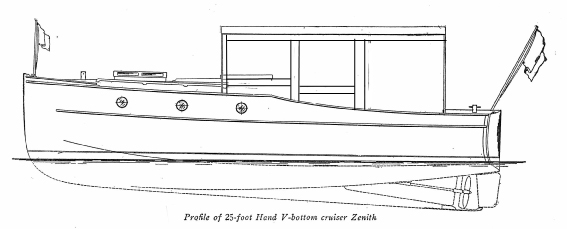
Zenith William HAnd 25 foot cruiser for sale by Roeboats, West Cork, 2 berth, 20 hp inboard dieselThis lovely raised deck 25 foot cruiser was designed by William Hand in the 1920’s. It is part of a series of boats that he designed that ranged from the smallest Zenith (below) all the way to eclipse at 40 feet. All of them featured a raised deck that produces a roomy and strong hull and to my eye anyway good looking boat. It is the quintessential classic cruiser look. You can easily imagine yourself enjoying an exhilarating trip across the bay to a friends cocktail party. This boat is no slouch, the lightly but strongly built hull, slips through the water at a tidy clip and is powered by a miserly 20hp inboard diesel. You shouldn’t think that these boats are just for zipping around the harbour, in their day Hand designed motor boats of this size and smaller have completed quite long cruises. One of these famously was from Long Island to Nova Scotia and long and demanding journey for any boat.

Plan of Zenith 25 foot wooden cruiser for sale by Roeboats ballydehob, 60,000 euro Down below there are all that is needed for you and a companion to cruise in comfort from bay to bay, with two berths, a galley and toilet. The boat as designed featured a canvas awning over the self draining cockpit but for a little more comfort in these northern climes a simple cabin can be built to keep you and your crew dry and cosy on those inclement days and keep the sun off on those glorious summer days that make you drop everything to get out in your boat.

If you would like your own custom built Zenith, a fine sea boat that will give you many years of pleasure and relaxation contact Tiernan Roe at 086 158 6937 or roeboats@ymail.com. Less than you would pay for a similar mass produced ugly plastic boat that will no doubt gobble as much fuel in a day as Zenith might use in a week.

28, 34 and 40 foot versions also available contact Tiernan for more info.

Roeboats, Ballydehob, Co. Cork, t:+353 (0)28 38973 m: +353 (0)86 158 69 37 e:roeboats@ymail.com

Home


Roeboats at the Ilen framing out and Baltimore Wooden Boat Festival.

Here are some photos of the Ilen the last wooden sailing cargo vessel built in Ireland in 1926 for use in the Falkland Islands. She’s currently undergoing a rebuild here in West Cork. I was invited to the framing out celebrations on the completion of the reframing of the boat. Next step is the planking and you can help by sponsoring a plank. They are also running traditional boat building workshops each month. They’ve also started a blog here.

Frames of wooden boat Ilen taken by Tiernan Roe of Roeboats custom boat builders

The Baltimore Wooden Boat festival was a tremendous success with up to 70 boats attending. Unfortunately I didn’t get any photos of the weekend as I was too busy talking to people about Ninigret. I’m exhausted having spent the entire weekend talking.

Roeboats, Ballydehob, Co. Cork, t:+353 (0)28 38973 m: +353 (0)86 158 69 37 e:roeboats@ymail.com

Home

Roeboats making waves across Atlantic.

I was delighted to be interviewed by Soundings Magazine for the May issue. I was even more delighted when this dropped into my inbox. I wasn’t expecting almost a whole page of coverage that will be read by as many a 155,000 boat enthusiasts all across the United States. Wow I’m almost famous first the radio interview and now this. If you’d like to read the article you can download a PDF here

Don’t forget that Roeboats will be attending the Baltimore Wooden Boat Festival the 28th to 30th of May and I’ll be showing the Ninigret I built last year. I also have a new print brochure for the festival which you can download a PDF here

Roeboats, Ballydehob, Co. Cork, t:+353 (0)28 38973 m: +353 (0)86 158 69 37 e:roeboats@ymail.com
Home

Roeboats on the Radio

Just to let you know that Roeboats was featured on RTE 1’s ( Ireland’s national radio broadcaster) maritime radio programme Seascapes last Friday the 7th of May. I tried listening to it but hearing my own voice was just too weird. Let me know if I sounded O.K. You can listen to Seascapes here.

Roeboats, Ballydehob, Co. Cork, t:+353 (0)28 38973 m: +353 (0)86 158 69 37 e:roeboats@ymail.com
Home